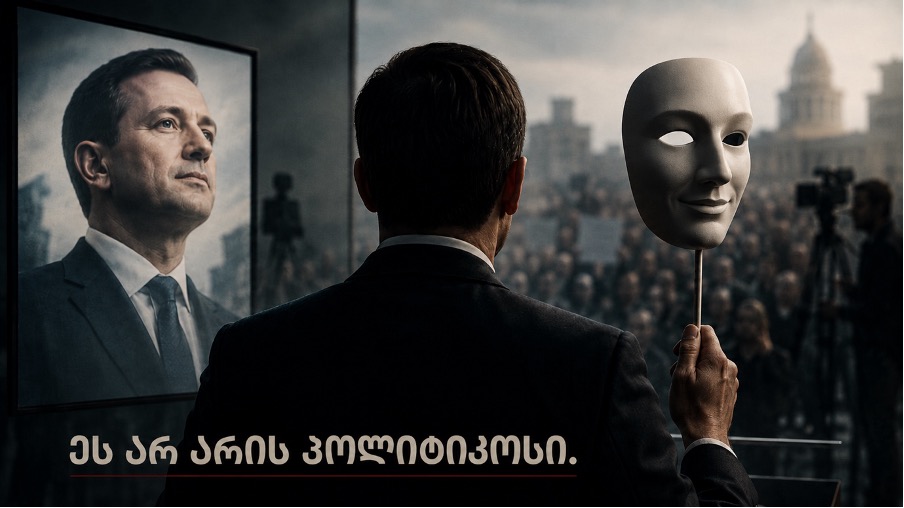
In contemporary politics, society often sees not the real politician but an image created of that person. Where does political communication end, and where does the image begin to prevail over reality?
Contemporary society faces one of its most difficult and fundamental tasks: determining where truth lies in an age of information overload, visual manipulation and ceaseless streams of information. Every day, the media space delivers hundreds of emotional images, slogans, statements and portraits; as a result, drawing a line between real events and the skilfully constructed impressions of them is becoming increasingly difficult. A citizen who wishes to make an informed political choice must constantly wrestle with his or her own perception — what am I actually seeing, and what impression has been imposed upon me?
Today, discerning the truth no longer means merely distinguishing falsehood from fact. The problem is often more complex:
an image may be genuine, but incomplete;
a statement may be factually correct, but taken out of context;
an event may be real, but selected and presented in such a way as to create an entirely different impression.
Modern individuals often find themselves confronting not an obvious lie but a representation that resembles reality, draws a certain basis from it, yet ultimately takes its place.
To understand this difficult political task more clearly, it is useful to recall a famous artistic paradox. René Magritte’s celebrated painting depicts a pipe beneath which appear the French words “Ceci n’est pas une pipe” — “This is not a pipe.” My purpose, of course, is not to offer an art-historical or aesthetic analysis of the painting. What interests me is the logic that the artist proposes.
At first glance, the inscription seems absurd and contradictory. The viewer sees a pipe, while the text says that it is not a pipe. The natural question is: if this is not a pipe, then what is it? The answer is simple: it is not a pipe but an image of a pipe. We cannot pick it up, fill it with tobacco or set it alight. It is only an image made of colours and lines that resembles a real pipe. Magritte’s inscription is therefore not a lie but, in the literal sense, the truth: the object before us really is not a pipe — it is an artistic representation of a pipe.
Michel Foucault even devoted a study to this painting, likewise entitled This Is Not a Pipe. I do not intend to examine Foucault’s work in depth here either. What matters to me is the aspect of his reasoning that concerns the relationship between a real object, its image and its name. There is a real pipe. There is an image of it. There is the word “pipe.” These three are connected, but they are not the same. The word “pipe” is not a pipe. Nor is a picture of a pipe a pipe. Both are merely signs that point towards the real object. Yet the human mind often works in such a way that it automatically identifies the sign with the object. For example, we simply call a tree depicted in a painting “a tree,” and we perceive a person captured in a photograph as the person himself or herself, although in reality we are looking at an image on paper or a screen.
Magritte disrupts this automatic identification. He warns us that resemblance does not yet mean identity. An image may closely resemble a real object, but it cannot become that object. It may give us a sense of reality, but it is not reality itself. That is precisely why Magritte called the work The Treachery of Images. An image seems to promise that it will show us reality, yet ultimately offers only a particular representation of reality. More precisely, perhaps the image itself betrays nothing. We make the mistake when we equate the image with the real object and take the representation for reality itself. This is where I wish to turn to the subject that is central for me in this instance — politics.
Foucault and Magritte’s reasoning is of interest because it gives us an important analytical key to understanding one of the most acute problems in contemporary politics. Just as there is a real pipe and an image of it, so too there is a real politician and that politician’s public persona. There is a particular individual, with his or her own qualities, abilities, interests, mistakes and decisions. At the same time, there is the person’s media image — a representation created through photographs, videos, slogans, speeches, specially selected catchphrases and/or emotional footage, which is then further disseminated through genuine or fake accounts on social networks, information shared in chats, and so forth. The particular individual and this “media image” are therefore connected, but they are not always identical.
Most modern citizens do not know a politician personally. They do not work with the politician every day, attend the preparation of his or her decisions, or see how the person behaves when the cameras are absent. Citizens know politicians primarily through a screen, a social network, television, a poster or a public speech. In other words, society often sees not the real politician but an image created of the politician.
Public-relations specialists, photographers, camera operators, copywriters, social-media managers and perhaps sometimes even psychologists work to create this image. They determine in advance what words the politician should use, the tone in which to speak, what to wear, whom to meet, where to be photographed, what emotion to express and what impression to leave on the public. The result is not merely political information but the creation of a particular political character.
One politician is presented as a strong and unyielding leader;
another as an ordinary person close to the people;
a third as an educated, European and modern leader;
a fourth as a defender of culture, traditions and national heritage;
a fifth as a compassionate person sensitive to human problems, and so forth.
Some of these qualities may indeed be real. Yet the purpose of political public relations is not merely to display existing qualities. Its aim is to use individual qualities, facts and images to create a complete impression that establishes a particular image of the politician in the citizen’s mind.
A politician may once meet a socially vulnerable family. The footage may be entirely genuine. The politician really speaks with people, genuinely listens to their problems and may even provide some assistance. Yet this single meeting is used to draw a broader conclusion: that the politician is generally a caring, sensitive leader focused on the people’s problems. The fact may be true, while the overall impression created from it is exaggerated.
This is one of the principal powers of the political image. It does not always require a lie. It is often enough to select a certain part of reality, repeat it and present it as the whole. For example:
A photograph showing a politician in rubber boots, standing in the mud in the rain without an umbrella, does not automatically demonstrate devotion to the people; it is a visual code for devotion.
A video in which a politician eats with soldiers does not in itself prove genuine unity with the armed forces — it creates a scene and a corresponding impression of unity.
A photograph taken among books creates visual signs of education, but cannot automatically establish intellectual ability.
A photograph with a dog does not necessarily prove a love of animals.
A video recorded at a construction site is not evidence of a successful infrastructure policy, just as walking among the people does not mean that a politician is guided by their interests when making real decisions.
Applying Magritte’s logic, we could notionally caption each such image:
“This is not a caring leader — it is an image of a caring leader.”
Or:
“This is not strong government — it is a visual representation of strong government.”
In political public relations, a third element often emerges between the object and its image — the narrative.
We may therefore identify three distinct levels:
a) the real politician;
b) the politician’s public image;
c) a political narrative about the politician created through the politician’s public image.
For example, there is a politician attending a meeting. There is a photograph of that meeting in which the politician is surrounded by people. Then there is the text: “A leader who always stands beside the people.”
The first is a particular individual and a particular event. The second is a selected visual representation of that event. The third is the political meaning assigned to that representation.
In the end, society often remembers precisely this third level. The contest in modern politics therefore no longer revolves only around decisions and programmes. It also concerns who can create a more convincing public impression of themselves. A politician’s success is not always determined solely by what the politician does. How the person appears, what is associated with that person and what people feel when they see him or her often become no less important.
Doing the work is one thing. Showing the work being done is another. Creating the impression that work is being done even when no real result exists is a third thing altogether.
It is in this third case that the treachery of images reaches its clearest political form.
The French philosopher Jean Baudrillard described this condition through the concept of the simulacrum — when an image is no longer a simple reflection of reality, but takes its place and itself begins to determine what we regard as real. In the world of public relations, genuine action may gradually become secondary, while the impression created of it becomes primary.
A politician may care less about solving a problem fully and more about how the response will appear to the public. In such a case, even a political decision becomes a scene staged for the media. An event, for example, is planned to produce a good shot. A meeting is held not for genuine dialogue but to record an emotional video. A statement is formulated not to explain an issue fully, but to create a short banner phrase or so-called “card” that will spread quickly through the information space.
Politics is gradually moving from the sphere of action into the sphere of representation. Technological progress and social networks have brought this process to a qualitatively new stage. Whereas a traditional photograph or video was generally based on a real object or event, in the age of artificial intelligence and deepfakes a convincing image no longer even requires a direct connection with an actual event. A video, voice recording or photograph may be created without the participation of a real person and still look so persuasive that the viewer takes it for a real event. At the same time, today’s citizen is no longer merely a passive viewer before a screen. With every like, share or meme on social networks, he or she becomes a disseminator and sometimes a co-author of the representation. Fairness requires us to acknowledge that this choice is not always entirely free. It is influenced by social-media algorithms, political polarisation and the natural human tendency to believe more readily what accords with one’s existing views.
Accordingly, the treachery of the image today involves not only its creators, but also the technological systems that disseminate it and sometimes the viewer as well.
Here we encounter an important paradox: a pipe depicted in a painting cannot cause a real fire, but a political image can produce real political consequences. Under the influence of these images, societies support politicians, laws, governments, political courses and sometimes even military decisions. An unreal or artificially created image can therefore produce an entirely real reality.
It should also be said that none of the foregoing means that political communication is inherently bad. The public has the right to know what the government is doing, what the opposition is proposing and what decisions political leaders are making. Every politician is obliged to inform citizens about his or her work. The problem begins when communication ceases to report on activity and instead replaces it:
when a politician looks good but governs badly, or does not govern at all;
when statements are convincing but decisions are ineffective;
when the slogan is strong but the programme is empty;
when the politician stands close to the people in the frame but ignores their needs in real politics.
Here we are dealing not merely with the creation of a political image, but with the image’s domination of reality.
Yet fairness requires another important distinction. Not every image is a lie, and not all public relations are manipulation. A politician’s public persona may also reflect real qualities. A person may genuinely be educated, caring, courageous or competent, and political communication may simply inform society of those qualities. The problem is not the existence of the image itself, but the failure to distinguish the image from reality.
The public should understand that a public image is always selected. A camera cannot show everything. A photograph captures one second; a video, a particular segment; and a statement is a text prepared in advance or removed from a particular context. A broader reality always remains outside the frame.
In political assessment, therefore, the principal question should not merely be: what does the politician look like? We should ask: what does the politician do? What results do the decisions produce? To what extent do the statements correspond to the actions? What are we being shown, and what is being concealed? What remains outside the frame?
The best defence against the treachery of political images is not to reject every image, but to adopt a critical attitude towards them. A critical attitude means understanding that a photograph may be part of a fact, but is not the whole fact. A video may depict a real event, but it remains the product of a selected point of view and editing. A political slogan may convey a particular idea, but cannot fully replace the actual substance of politics.
The person standing before Magritte’s painting is seemingly told: do not forget that what you see is not a real pipe. A citizen standing before the modern political screen needs a similar warning:
This is not a politician. This is an image of a politician;
This is not the whole reality. It is a selected frame, a particular point of view and part of a particular political narrative.
A politician’s true character is ultimately revealed neither on a poster nor in a slogan, an emotional video or a carefully staged photograph. It appears in decisions, responsibility, the correspondence between word and action, and the real results of the person’s work. Magritte’s pipe reminds us that an image is not the object. Political experience shows us that an image of a politician is not the politician either.
One of the principal tasks of contemporary political thought is therefore to preserve precisely these distinctions: between real action and its staged representation, between governing and the imitation of governing, and between a leader and a carefully constructed image of a leader.