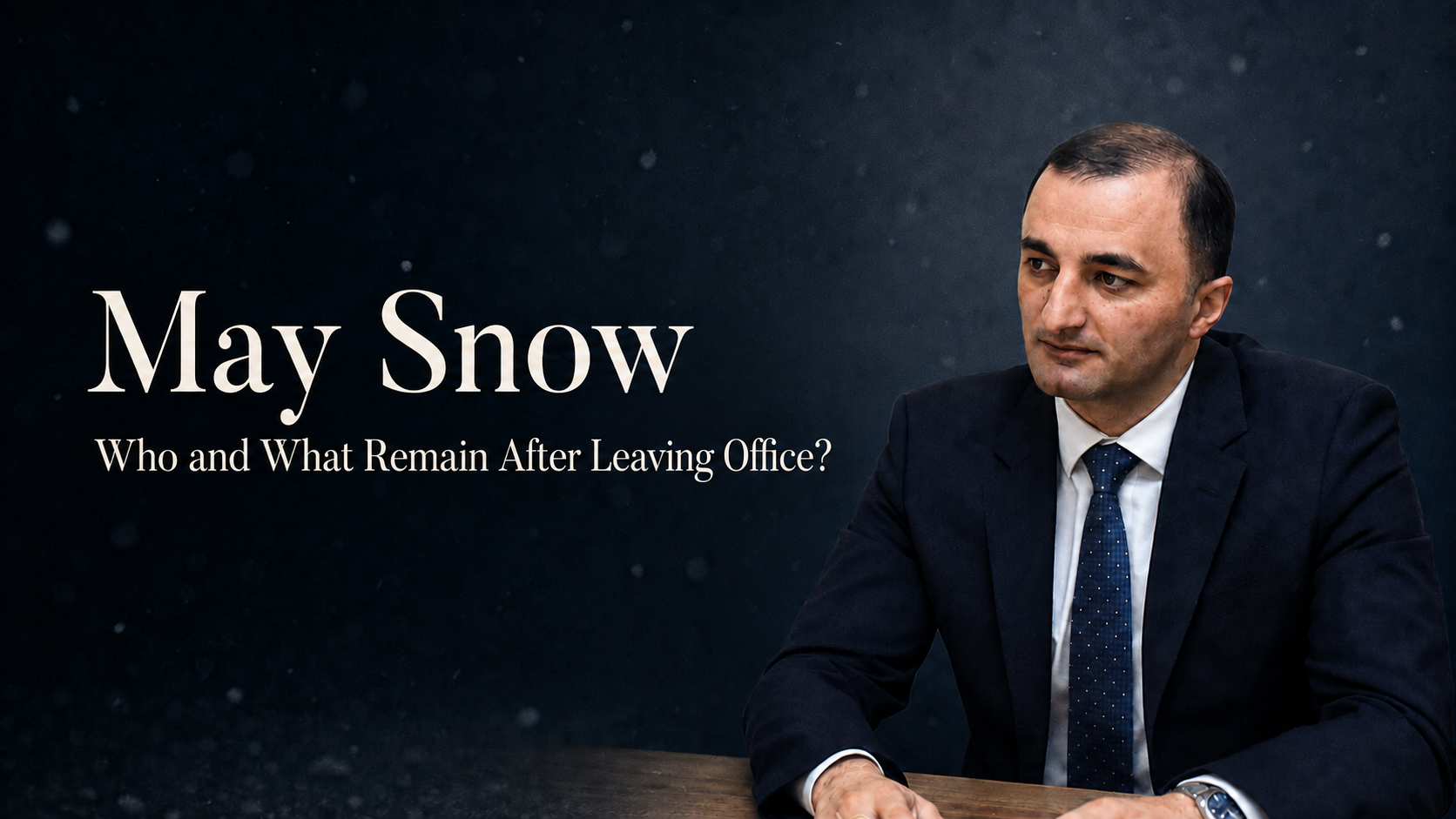
Leaving office creates a distance that reveals the temporary nature of power, the true character of relationships and a person’s inner resilience in a different light.
Some experiences cannot be fully understood while you are still living through them. Only with time and a certain distance do you begin to see what was temporary in them and what was real.
Leaving office creates precisely this kind of distance, and it reveals the true nature of the relationships around you. You do not end up alone — you simply discover, perhaps for the first time, who stood by you and who stood only by your seat of power.
Office often has its own “friends” — people who, in reality, belong not to the person but to power. They appear when your word can alter a decision, your phone call can open a door, and closeness to you represents a certain opportunity for them. Their attention can be so convincing that it is hard to tell where sincere human connection ends and calculation begins.
Yet office is temporary. When it disappears, this category of people disappears from your life with it — like snow in May: suddenly, silently and, at first glance, without leaving a visible trace.
Snowfall in May is unusual. For a moment, it can transform the entire landscape, but everyone knows it will not last. Soon it melts, and where everything was white only hours earlier, no trace remains. Some of the people gathered around power prove to be just like that: their loyalty is impressive but brief; their closeness intense but conditional; and their words sound convincing only as long as the temperature of power suits them.
Yet “May snow” does not disappear without a trace. An invisible mark remains in the sadness left by people’s sudden disappearance. It is not simply hurt caused by the end of a particular relationship. It is a more complicated feeling: you look back on your past and try to understand what the relationships you once regarded as genuine friendship really were.
And yet, this is not altogether a bad thing.
On the contrary, leaving office is not only a human but also a kind of political filter. It shows clearly who cared about you — your ideas, your work, your experience and who you are — and who cared only about the door you could open. After power is lost, relationships are cleansed: the excess noise, formal loyalty and exaggerated attention that often pass for friendship disappear.
That is when the true test of friendship and loyalty begins.
Machiavelli’s observations about human nature in The Prince often strike us as harsh and cynical. Yet political experience shows that his realism was not accidental: many people are more readily swayed by power than guided by loyalty; and many remain loyal only as long as there is benefit in the relationship. Accepting this is especially difficult when it becomes part of your own life rather than an abstract theory.
A holder of public office lives largely amid noise. Daily life is filled with calls, meetings, invitations, requests, responsibilities and constant demonstrations of “loyalty.” Someone always needs your opinion, consent, support, or simply to be seen with you. Over time, you may begin to believe that this attention naturally belongs to you.
But often it belongs not to you, but to your office.
After resignation, the noise stops and silence settles in. The phone rings less often, the calendar empties, some people disappear, while others suddenly begin telling their own past differently. It is in this silence that you see most clearly who truly remained.
This may cause disappointment, but it can also be seen differently — as liberation and an opportunity to view your circle without illusions and value what is genuine more deeply. Late, perhaps, but finally I became convinced: one genuine person is worth far more than a hundred “May-snow” friends.
There is a profound human joy in discovering such people — or in having their sincerity reaffirmed. They are not merely part of your circle, but a sincere part of your history. They do not disappear with the office because they were never attached to the office in the first place. They stayed with you and did not try to rewrite their own past.
In politics, relationships often revolve around interest, influence and future prospects.
That is why a person who bases a relationship not on benefit, but on a shared journey, respect and human loyalty, is especially precious. At that point, loyalty ceases to be merely an emotional category. It becomes an ethical position and an inner culture — a culture of respect for a shared journey, shared struggle and shared past.
But leaving office tests not only other people. It tests you as well.
For a politician, resignation is a kind of inner turning point. It is the moment when the everyday realm of the “possible” ends and what remains is the memory of the “desirable” — of what you wanted to do but had no time to complete; what you tried to change but could not fully accomplish; and the decisions you had to make through difficult choices between the possible and the desirable.
After leaving office, you may sometimes look in the mirror only for appearance’s sake. But when you look at yourself closely, alongside sadness and fatigue you also see how much patience and experience came with it all. It is no longer the sadness of defeat — it is more the feeling of a road travelled, accompanied by inner strength and an understanding of one’s own experience.
Despite nearly a decade in office, I did not experience an identity crisis after resigning. I felt emotionally tired, but I did not feel that I had lost myself. Perhaps because office was an important part of my life, but I never wanted it to become the sole definition of who I was.
Here the most important question arises: who remains when office no longer defines a person’s everyday life?
Public office gives a person the opportunity to influence processes, make decisions and shape institutional reality. But it also creates a particular psychological environment: a person may gradually identify with the role and interpret attention generated by office as a measure of personal importance. In that case, the end of power is no longer merely a change of workplace — it becomes a personal void.
Seeing this boundary is not easy. While you are at the centre of the system, meetings, decisions, responsibilities and the environment’s constant response create an illusion of permanence. Yet one of power’s central qualities is its temporary nature.
After leaving office, for the first time — or for the first time with such clarity — you see what around you was genuine, and how much was connected not to you as a person but to your position. But at that same moment, a new possibility arises: to see yourself without office.
Sometimes office is not only an opportunity but also a framework — a system that shapes a person’s daily life, language, behaviour and self-perception. Leaving, therefore, is not always merely a loss. Sometimes it is also liberation: an opportunity to meet yourself again and ask what you can do when you no longer possess formal power, but still possess experience, knowledge, a sense of responsibility and something to say.
If a person’s entire identity was built solely on status, the end of power will be followed by emptiness. But if ideas, inner strength and the capacity for thought also existed beyond office, leaving is no longer the end — it becomes the beginning of a new stage.
Leaving office does not mean withdrawing from politics, just as continuing to speak about public affairs does not mean being unable to let go of office. Even without formal power, the possibility remains to think, create, share what you have learned with others and influence public life.
With time, May snow melts. The people who accompanied only the office disappear as well. But those whose loyalty is not determined by the political calendar remain. Experience remains, as does the possibility of seeing a closed door not as an ending, but as the opening of a new space.
In the end, what matters is not how many people stood around you while you held power. What matters is who remained when the May snow melted — and who you yourself remained.