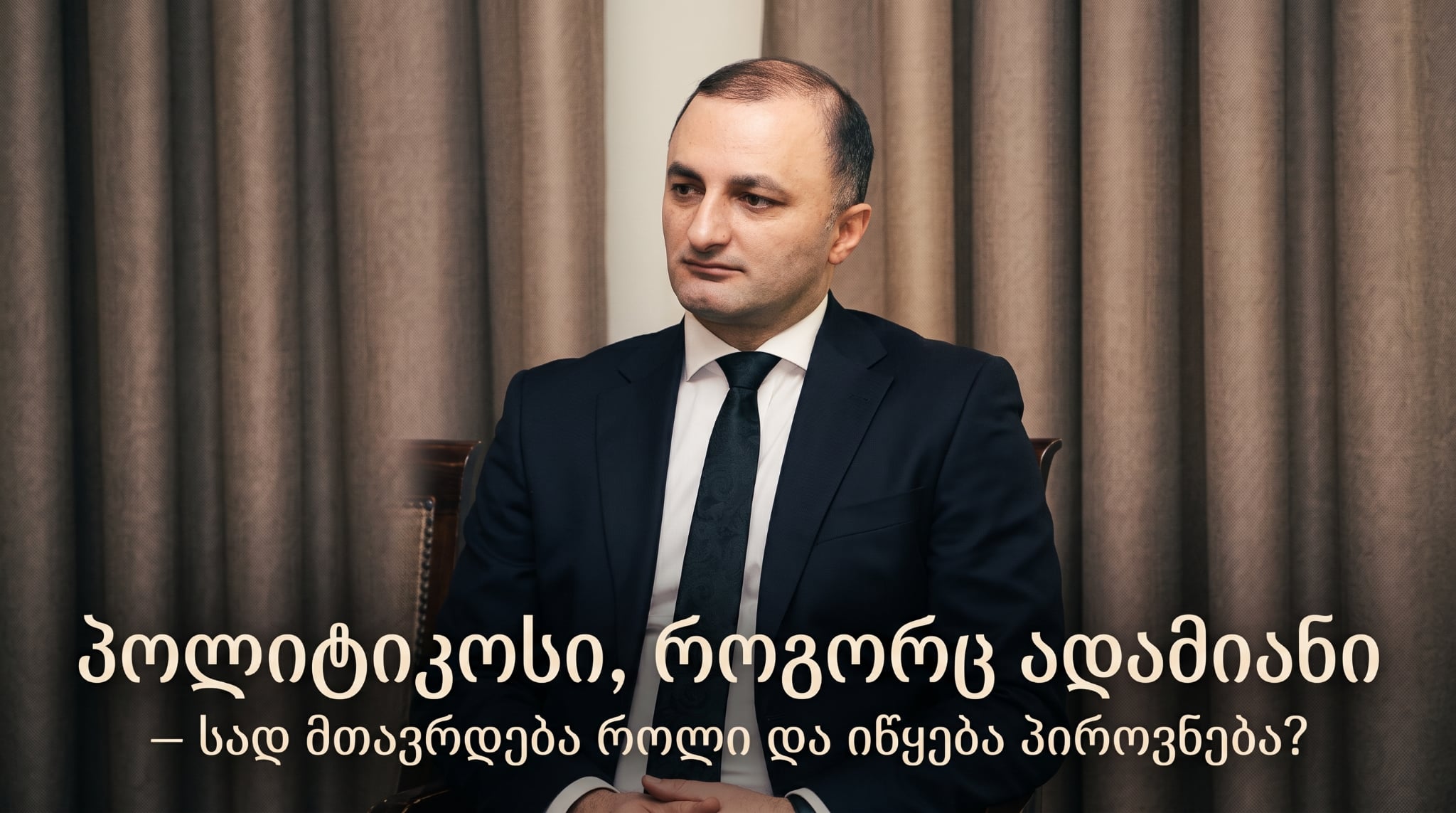
A politician is at once an individual, a performer of a social role, a holder of power, and an object of public expectations. He must constantly move between two spheres: on one side stands his private “self” — his feelings, values, doubts, and fears; on the other stands the political role assigned to him by society, his party, the state, and the surrounding environment. It is between these two spheres that the politician’s inner drama begins.
When we speak about politics, attention usually turns to institutions, elections, power, parties, ideologies, and the technical aspects of governing the state. Yet behind all of these there is always a human being — with fears, ambitions, illusions, convictions, and inner contradictions.
That is why politics cannot truly be understood unless we also try to understand the politician himself — not merely as a holder of office, but as a human being.
A politician is at once an individual, a performer of a social role, a holder of power, and an object of public expectations. He must constantly move between two spheres: on one side stands his private “self” — his feelings, values, doubts, and fears; on the other stands the political role assigned to him by society, his party, the state, and the surrounding environment.
It is between these two spheres that the politician’s inner drama begins.
In public life, a politician lives under constant scrutiny. He is watched, discussed, criticized, praised, burdened with expectations, and then judged by those very expectations. Gradually, he learns to control his emotions and reactions, because in politics even a single spontaneous remark can become the subject of prolonged public debate. Over time, such an environment also affects a person’s self-perception. A politician no longer sees himself only through his own eyes — he begins to see himself through the gaze of society, the media, supporters, and opponents.
This is precisely why one of the most difficult tasks in politics is to preserve one’s sense of self. The greater the power and public visibility, the harder it becomes to distinguish between the real person and the role he performs. Sometimes a politician becomes so closely identified with his status that he can no longer tell where the office ends and the person begins.
Human self-perception is not merely an internal process. It always takes shape through interaction with the surrounding world — within a system of social roles, relationships, recognition, and expectations.
Reflecting on the social nature of human beings, José Ortega y Gasset writes that one of the first signs of sociality may be found in the necessity of “taking one another into account” and in mutual interdependence.[1] This idea clearly suggests that a person cannot construct the “self” as a completely isolated and autonomous reality. The self is formed through coexistence and interaction with others.
The social environment does more than offer rules of conduct. It influences a person’s self-esteem, sense of significance, and understanding of his place in society. People often come to see themselves through the gaze, judgment, and recognition of others.
Personal identity therefore constantly balances between individuality and the influence of the social environment — between, on the one hand, the desire to preserve one’s unique “self” and, on the other, the need to remain part of society.
George Herbert Mead explored this question with particular depth. In his view, the “self” is formed through the process of social interaction. A person comes to perceive himself through the reactions, judgments, and expectations of others. Mead writes: “The self is something which has a development; it is not initially there, at birth, but arises in the process of social experience and activity.”[2]
Charles Horton Cooley developed a similar idea in his well-known concept of the “looking-glass self.” According to Cooley, people perceive themselves as if through a social mirror: they imagine how others see them, how they are judged, and then shape their own self-perception on the basis of those imagined assessments.[3]
Contemporary social media gives this “social mirror” even greater importance. Today, the “self” often becomes a product of reactions, likes, comments, and public perception. A person lives not only through his own inner self, but also through his social image.
For a politician, this process is especially intense. When a person spends years in an environment where his responsibilities, relationships, daily life, and public perception are tied to a particular office, that office gradually ceases to be merely a function — it becomes part of his identity.
A person begins to perceive himself not simply as an individual, but as a chairperson, minister, director, or holder of some other status — as someone who has influence, whose words are listened to, and whose decisions have consequences.
This process usually unfolds almost imperceptibly. Public attention, decision-making, formal and informal respect, and the special treatment shown by others create a psychological environment in which a person gradually merges with his role.
Erving Goffman describes this relationship through a dramaturgical approach. In his view, people perform different roles in different social settings, while a “performance” is the activity through which an individual creates a particular impression before others. Goffman also discusses the condition in which a performer may ultimately come to believe in the role he is performing.[4]
This is where the central question emerges: where does the social role end and the person begin?
A politician’s inner world becomes particularly complex under conditions of power. Power does more than give a person the capacity to act — it also changes the reality around him.
People’s attitudes change, the manner in which they speak changes, the degree of candor changes, and the very nature of relationships changes. Around a politician, an environment may gradually emerge in which people say not what they actually think, but what they believe the person in power wants to hear.
As a result, a politician may find himself in a world where maintaining direct contact with reality becomes increasingly difficult. The danger grows that he will come to see society not as it actually is, but as it is presented to him by those around him.
At the same time, politicians almost never make decisions under ideal conditions. Often the choice is not between good and bad, but between bad and less bad. Politics, therefore, cannot be only a realm of ideals — it is also a realm of responsibility.
A politician constantly operates under the pressure of reality, time, the balance of forces, and historical circumstances. A political decision is often not the realization of an absolute truth, but a choice among what is possible. It is in such choices that not only political skill, but also inner strength and responsibility are revealed.
The tragedy of the politician does not lie only in the temptation of power. It also lies in the fact that, in politics, a person rarely belongs entirely to himself. His time, his words, his mistakes, his victories, and often even his private life become part of the public sphere.
For this reason, one of the most difficult tasks for a politician is not only to govern a state or an institution, but also to preserve his inner balance and his connection with reality.
What Remains After Leaving Office?
A person may become so accustomed to his function, status, and influence that his political or professional role becomes the principal basis of his self-identification. In such a case, leaving office is no longer simply a change of workplace — it is experienced as an inner void.
Yet there is another possibility. Sometimes it is precisely after leaving office that a person begins to rediscover himself — now without status, protocol, or institutional power.
Here the most important distinction becomes clear: for someone who lived only through office, what remains afterward is mainly the past; but for someone who had an inner world, ideas, and a sense of identity beyond office, a future remains as well.
Ultimately, understanding the politician as a human being allows us to see politics as more than a collection of cold institutional processes. Politics is also a human condition — with its weaknesses, ambitions, convictions, mistakes, and constant inner struggle.
Before we judge politics, perhaps we first need to understand the human being who lives within it. Yet it is no less important for the politician himself to keep asking: beyond office and public role, who am I?
An honest answer to that question may be one of the most important tests in a person’s relationship with power.
Sources
[1] José Ortega y Gasset, Man and People, Georgian translation from Spanish by Zurab Tsikaridze, eds. Revaz Mirianashvili and Nino Pipia (Tbilisi: Sakartvelos Matsne Publishing, 2016), p. 97.
[2] George Herbert Mead, Mind, Self, and Society from the Standpoint of a Social Behaviorist, ed. Charles W. Morris (Chicago: University of Chicago Press, 1934), p. 135. The Georgian quotation was translated from English by the author.
[3] Charles Horton Cooley, Human Nature and the Social Order (New York: Charles Scribner’s Sons, 1902), chap. V, pp. 151–153.
[4] Erving Goffman, The Presentation of Self in Everyday Life (Garden City, NY: Doubleday Anchor Books, 1959), pp. 17, 22.