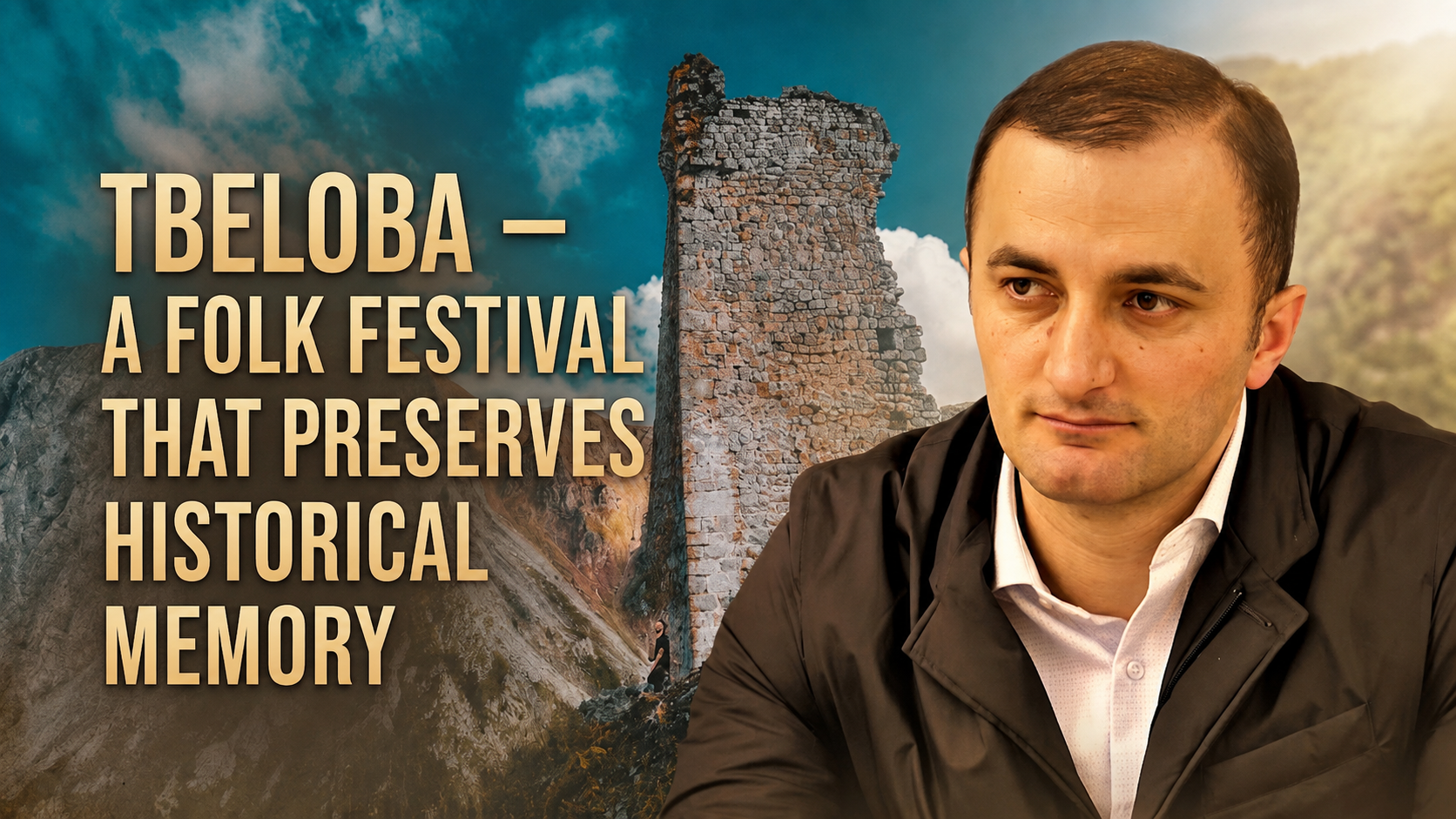
I extend my congratulations on Tbeloba to all of Georgia, and especially to the residents of the Skhalta–Khikhani Valley and my dear people of Khikhadziri. May this day always remind us of the values, knowledge and spiritual strength that connect generations and guide us towards the future.
Some holidays remain no more than dates marked on the calendar, while others have a significance that extends beyond the celebration itself. They become a kind of bridge between past and present and remind us not only who a particular person was, but also who we are and what we choose to remember.
Tbeloba is precisely such a celebration. Its history begins in 1979. The first Tbeloba was held in the Skhalta–Khikhadziri Valley and was dedicated to Tbel Abuseridze, the thirteenth-century Georgian writer, scholar, thinker and cleric. It later developed into a tradition. In 2002, the Holy Synod of the Georgian Orthodox Church canonised Tbel Abuseridze, adding a spiritual dimension to his commemoration.
Yet the essence of Tbeloba cannot be conveyed merely by listing dates and historical facts. The figure of Tbel Abuseridze reminds us that the Middle Ages were not solely an age of battles, kings and churches. There were also people who sought to understand the world, systematise knowledge, write, teach and think. His legacy includes important reflections on chronological, astronomical and calendrical matters, as well as ecclesiastical literature and historical accounts. All of this reveals thirteenth-century Georgian intellectual life as a far more diverse world. This brings us to the central question:
Why should a person living in the twenty-first century remember a thinker who lived eight centuries ago?
Perhaps because a society is defined not only by what it creates today, but also by what it preserves from its past and passes on to future generations. Historical memory does not exist on its own; it must be preserved. Countless people lived in the past, but only a small number remain in collective memory. A festival, therefore, is not merely a remembrance of the past. It is also a choice. When a society gathers every year around the name of a person who wrote, studied and created centuries ago, it does more than recount his biography. It also tells itself that knowledge, education, thought and culture are values worth remembering. This is one of Tbeloba’s principal meanings: it makes historical memory visible.
For me, Tbeloba also has another, personal dimension. Tbel Abuseridze came from the valley where my village is located, and Tbeloba itself is held in Khikhadziri. For me, therefore, this celebration is not merely a historical fact or a cultural tradition. It is connected with a place, its people and an environment I have known since childhood. Perhaps that is why I feel even more strongly that historical memory is at its most alive when it is tied to a particular land and to personal experience.
At the same time, this connection also reveals Tbeloba’s broader historical significance. The legacy of Tbel Abuseridze reminds us that, centuries ago, the Skhalta–Khikhani Valley was not an isolated periphery detached from the Georgian cultural world. A person living here wrote texts, reflected on scholarly and ecclesiastical questions and participated in the intellectual life of his age. From this perspective, Tbeloba tells us even more about the history of Adjara. It reminds us that Georgia’s cultural history is not merely the history of its great cities. Knowledge and culture also had powerful centres in the mountains, in different valleys and villages.
Yet every tradition faces a danger over time: form may take the place of substance. The stage, music, speeches, guests and congratulations may remain, while the answer to the central question gradually disappears: why have we really gathered here?
Annual repetition alone does not keep a tradition alive. It is important that every new generation be able to understand its meaning. One of Tbeloba’s central purposes should therefore be to ensure that Tbel Abuseridze does not remain merely a historical name. Young people should know more about his works, his age and his intellectual legacy. The festival itself should become a living space for discussion of education, scholarship, history and culture. Tbeloba will then no longer be only a day of respect for the past. It will also become an occasion to think about the future.
Ultimately, the essence of historical memory lies in the fact that, although we cannot change the past, we can choose what to carry from it into the future. There is much to carry forward from the legacy of Tbel Abuseridze: an unquenchable thirst for knowledge, a culture of thought and a belief that the words and ideas created by a human being often live far longer than their own age. Eight centuries later, his name continues to bring people together.